
I partner with ambitious students in grades 6–12 to build on what great classrooms start — deeper reading, critical thinking, and a documented portfolio of genuine academic growth. Sessions are virtual, 1:1, or in carefully selected peer seminars consisting of two to three, where each student is known beyond their name.
Your Child Was Built to Think.
What BTT Builds
Habits that take root early — and last.
Each weekly session builds:
- Independent thinking. The habit of forming opinions from verifiable facts, not feelings — making your child less susceptible to groupthink and to ideas pushed without evidence.
- Sharper problem-solving. A hard question becomes manageable when broken into prioritized, sequenced parts — a portable habit that travels across subjects and into everyday decisions.
- Sound judgment under pressure. Students learn to slow down before answering — to ask what’s actually being asked, weigh what they know, and commit to a position they can defend. They become harder to rush into a bad decision.
- The confidence to be questioned. Seminar Defense trains students to hold an idea under scrutiny without folding or escalating. Built early, it compounds into a lifetime of confidence.
What Your Family Receives
Proof you can hold — at every stage of the year.
Across the year, your family receives:
-
At the start
A personalized Growth Plan. Built from our intake conversation — not a template. A written portrait of your child as a thinker, an honest read of strengths and gaps, and a roadmap tailored to where your family wants to go: a tiered reading sequence, a skill-building path, and a milestone calendar. It is the diagnosis and the direction in your hands before the first session.
-
The Binder. The program’s signature artifact, and the most tangible thing in it. The Binder is your student’s operating system for the year — the weekly plan, the reading architecture, and a growing record of every analytical response and tool map they produce. Open it in June, and you can watch a full year of thinking accumulate, page by page.
-
Every week
A standing hour with me. Not a curriculum handed off, and not a rotating tutor. One hour, every week, built around your student’s work — a Socratic exchange that trains them to reason clearly, write with precision, and defend a position out loud. This is the relationship the entire program runs on, and I personally lead it.
-
Every quarter
A written Progress Report. Four times a year, a written assessment of your child's growth across the program’s analytical domains is conducted. This is the document a parent can carry into a school conference or use to advocate for their child — evidence, in writing, of what is developing and where it is headed next.
-
At year-end
A complete record — and my summary in writing. The print-ready portfolio of the full year: completed analytical responses, a growth grid from baseline through year-end, the reading record, and a narrative summary written in my words. Built to stand on its own — and to stand alongside any application that asks who your child is as a thinker.
My Mission
Built to Think cultivates young thinkers who interrogate, synthesize, and defend their own conclusions — for the student ready to think for themselves, and for the parents unwilling to leave that to chance.

Why BTT Exists
Some students are ready to go further than any classroom can take them. Great teachers work hard to serve every student in the room. What they cannot do — structurally, not for lack of skill or dedication — is give one student unlimited depth, unlimited time, and a program built entirely around that student. BTT exists for the student who is ready for exactly that.
That program begins with seeing the student clearly — their genuine strengths, the areas where they're growing, and the dimensions that rarely get captured in one place: academic depth, athletics, leadership, the arts, service, awards earned, communities joined. From that baseline, the work is forward-looking. We help the student articulate who they are, sharpen the areas worth amplifying, set a direction for where they want to go, and build a picture that high schools and college admissions boards can actually recognize.

The Evidence Is Clear
- According to PISA 2022, U.S. students performed below many peer nations in mathematics while scoring above the OECD average in reading. These results suggest that high-achieving students may benefit from depth-focused, personalized academic engagement that extends beyond the traditional classroom.
- The 2024 NAEP results show that only about 30% of U.S. 8th graders performed at or above the Proficient level in reading, while a record 33% scored below the Basic level.
- State and district-approved reading lists have narrowed significantly over the past decade, limiting exposure to complex, diverse, and cognitively demanding texts.
- Common Sense Media research shows the average teenager spends more than eight hours daily with entertainment screen media, much of it on short-form, algorithm-driven platforms that compete with sustained attention and deep engagement.
BTT partners with that reality. BTT does not replace the classroom — it extends what the best classrooms inspire. For the student who is ready to read more deeply, write more precisely, and think more independently, BTT provides the structure, the rigor, and the dedicated practitioner that makes that growth documented and real.
What a BTT Student Learns to Do
Read with a Purpose
Most students read to find out what happens. BTT students read to find out what a text is arguing. They learn to identify a claim beneath the surface of a story, locate the evidence an author deploys, and decide whether the argument holds. That skill — reading for argument rather than plot — changes how a student engages with every piece of writing they encounter for the rest of their lives.
Research Insight
A University of Cambridge-led study of more than 10,000 adolescents found that reading for pleasure was associated with stronger cognitive performance, improved mental well-being, and beneficial differences in brain structure. Approximately 12 hours per week appeared optimal in the study’s findings.
Sun et al. (2023), Psychological Medicine
Build an Argument from Evidence
An opinion is not an argument. BTT students learn the difference. They learn to start with a defensible claim, build toward it with specific evidence, and explain the reasoning that connects the two. They do this in writing. They do this out loud. They do this until it becomes the natural way they think.
Defend a Position Under Examination
Knowing what you think is one thing. Holding it under challenge is another. BTT students practice both. Through the Seminar Defense format, students learn to present a position, respond to counterarguments, and revise their thinking when the evidence demands it — without losing the thread of what they originally set out to say. That is not a debate skill. It is an intellectual character skill.
Think Across Disciplines
BTT students are trained to ask better questions. The curriculum draws deliberately from fiction, nonfiction, history, science, and civic life because students need exposure to all of it — the best thinking happens when ideas from one domain illuminate questions in another. A student who can move fluidly across disciplines does not compartmentalize knowledge. They synthesize it.
Write with Precision
Vague writing is vague thinking made visible. BTT's writing framework — built around claim, evidence, and reasoning — trains students to say exactly what they mean, cut what they do not, and produce prose that earns the reader's trust. This is not grammar instruction. It is the discipline of making an argument on the page.
Know Themselves as Learners
The most durable thing BTT develops is self-awareness. Students who can identify how they think — what they do well, where they get stuck, how they recover — become students who can improve themselves without being told to. That metacognitive capacity is what separates students who peak in middle school from students who keep growing.
A Three-Way Partnership
BTT works because three things hold. BTT brings the structure, rigor, and weekly work. The student brings the discipline to do the reading and writing between sessions. And the family creates the conditions at home that make independent reading possible — protected time, a place to work, and the steady expectation that the work gets done.
What we ask of parents is direct. Support the reading at home. Respond to BTT communications within a couple of days. Raise concerns directly with Doug as soon as something needs to change. During sessions, let the student own the room — your role is to make sure the work happens; the practitioner's role is to make sure the work works.
The session itself is sixty minutes, weekly. Outside the session, the student's work runs one to five hours per week depending on level — set at intake, calibrated to the student's existing schedule. BTT replaces undirected time. It doesn't stack on top of everything else.
Built for Students Who Are Ready for More
BTT is an acceleration. Our program is designed for students in grades 6–12 who are already performing well and ready to discover what they are genuinely capable of when given the depth, rigor, and personal attention to do so.
You may be in the right place if:
- Your child reads above grade level and is ready to go deeper — analyzing, questioning, and synthesizing across texts and disciplines.
- You're thinking beyond grades — toward honors society recognition, advanced academic programs, and opportunities that reward documented intellectual growth.
- Your child is intellectually curious but hasn't found an outlet that takes that curiosity seriously.
- You want a documented, verifiable portfolio of academic achievement — not just test scores.
- You want something beyond the standard options — a practitioner-led program with genuine depth, a documented outcome, and a personal relationship with the person teaching your child.
- You want your child to work directly with an experienced practitioner — someone who will genuinely know them, challenge them, and hold them accountable by name.

A NOTE ON ENROLLMENT
BTT is intentionally small by design. If you're considering reaching out, I encourage you to schedule your intake early.

Built from Experience. Built for This Moment.
The founder of Built to Think began his career at Prudential before spending decades in management consulting at EY, IBM, and ADP, and then as an independent practitioner serving clients including JPMorgan Chase, Sony, ABB, MetLife, Makino, Framatome, Faurecia (FORVIA), ExxonMobil, Becton Dickinson, and Lonza — across finance, healthcare, advanced manufacturing, energy, and the public sector. A graduate of Rutgers University — B.A. and M.B.A. — with executive certifications from Northwestern Kellogg in Strategic Application of Artificial Intelligence and from the Wharton School as Chief Technology Officer, he brought to consulting the same discipline he now brings to students. The work was always the same at its core: take complex problems, apply rigorous frameworks, and build solutions that hold up under pressure.
He built Built to Think because he knows what it means — personally — to be capable and unseen. And he knows what changes when someone finally invests.
Then came a different challenge: helping a bright, capable young student build an academic program worthy of her potential.
The result was a BTT Student Development Portfolio — a comprehensive, structured record of one student's intellectual growth: tiered reading, a cognitive development map, a writing framework, external validation milestones, and a whole-student record spanning academics, performing arts, athletics, and civic engagement. Programs recognized it. Skills deepened. Confidence followed.
Built to Think was created to make that same rigorous, personalized approach available to other families — families who know their child is capable of more and are ready to invest in the journey that develops it.
My Approach
Three Phases. One Outcome: A Student Who Can Think.
Every BTT engagement follows a structured, three-phase process. I begin by understanding who your child is academically and as a thinker. We build a personalized plan. Then we execute it together, week by week, with accountability and visible results.
Evidence-Based Method
The BTT approach rests on peer-reviewed research in reading, discussion, and cognitive development.
The research behind the method →
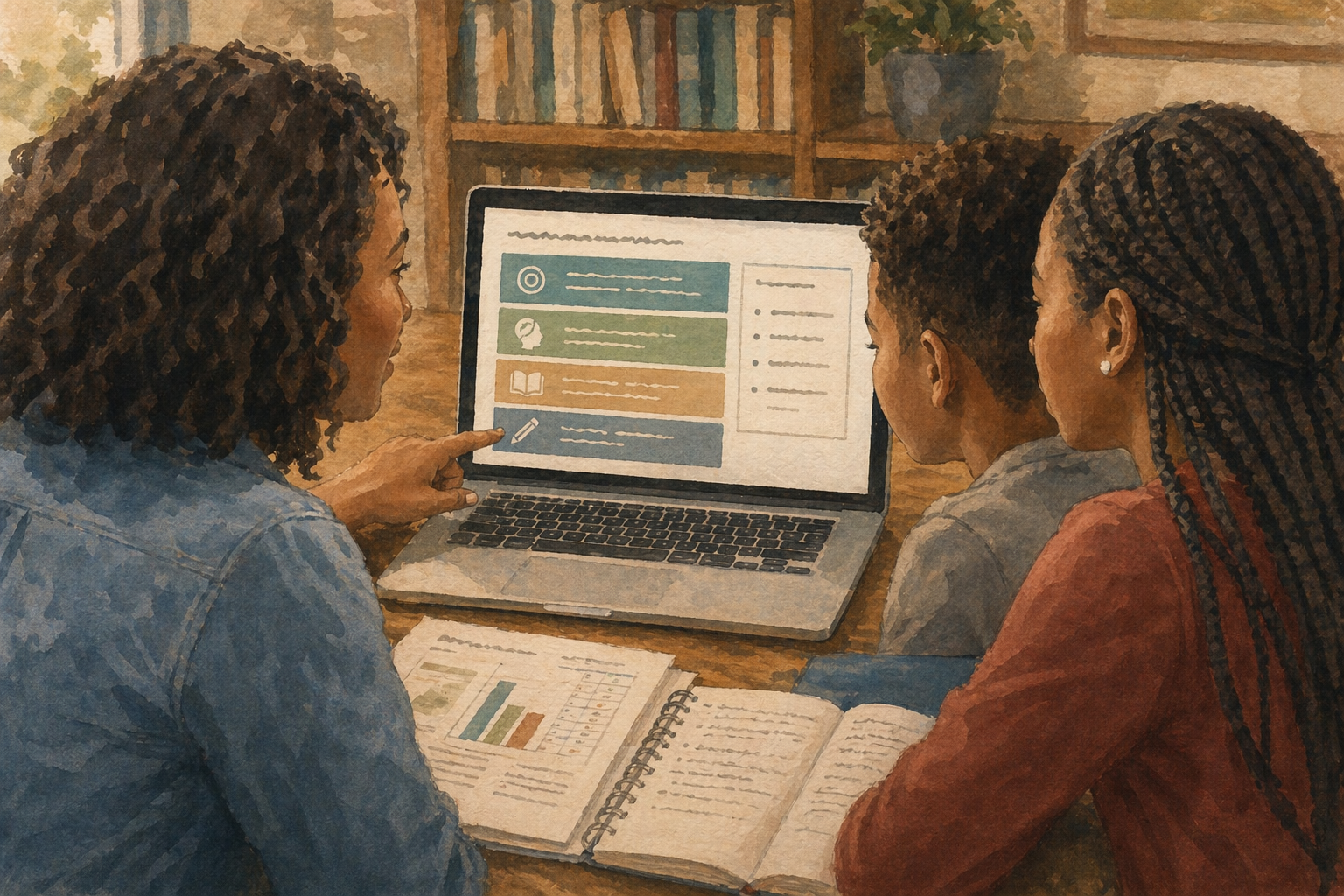

Phase 1 — Family Profile & Intake
I begin with an in-depth conversation with you and your child. I map academic history, interests, strengths, perceived gaps, and long-term goals alongside your family's aspirations: honor society recognition, competitive high school placement, summer program eligibility, scholarship positioning, or college readiness. We leave this phase knowing where your child is and where they're meant to go.
Phase 2 — Academic Assessment & Growth Plan
I review grades, available standardized scores, writing samples, and any existing enrichment to build a complete academic profile. Strengths are identified and amplified. Gaps are named honestly and addressed strategically.
From this foundation, I design a personalized Growth Plan: a tiered reading program, a cognitive skill-building sequence, a structured writing framework, and a calendar of milestones aligned to the external recognition opportunities that matter most to your family — honors designations, academic organization membership, and competitive program eligibility.
Nothing is generic. Every element is chosen for your child.
Phase 3 — Weekly Execution & Accountability
Students submit weekly assignments: written analyses, structured responses, reading reflections, and cognitive exercises. Each week includes a one-on-one review session, an interactive exchange that builds reasoning, sharpens argumentation, and gives students the experience of defending their own ideas.
Feedback is specific, honest, and forward-facing. We celebrate what's working. We name what to build next.
Beyond Skills — A Portfolio That Opens Doors
Most programs produce a better grade or a higher score. BTT produces something rarer: a documented, verifiable academic portfolio that demonstrates who your child is as a thinker.
By the end of a BTT program, your student will have built:
- A tiered reading portfolio across fiction, nonfiction, STEM, philosophy, and global literature — with written analytical responses for each text.
- A collection of analytical responses demonstrating the ability to reason, synthesize across sources, and defend conclusions.
- Documented cognitive growth across systems thinking, moral reasoning, rhetorical analysis, and metacognition — the ability to observe and reflect on one's own thinking.
- A record of external achievement — documentation of academic growth and whole-student development that positions students for honor society membership consideration, recognized advanced reasoning program eligibility, and qualification for nationally accredited gifted and talented programs.
- A personal academic summary document written by the student — in their own voice, ready for applications.

Real-World Example
The BTT model was built around a real student — a 7th grader focused on academic recognition and high school honors placement. Her program included a tiered reading portfolio spanning 12 titles across four cognitive levels, 20+ structured analytical writing pieces, a mapped cognitive skill progression, and an external validation plan aligned to academic recognition standards and advanced program eligibility, including nationally accredited gifted and talented programs. Her binder became a living document of intellectual growth — built to stand alongside any application as proof of who she is beyond the classroom. That program is the blueprint for every BTT engagement.
The Differentiator Is a Person, and The Framework.
Scale is the defining feature of most academic programs- and scale is precisely what makes deep, personalized engagement impossible. What no high-volume program can offer, regardless of its quality, is someone who actually knows your child. Because the work requires knowing a student's intellectual style, their gaps, their confidence level, what excites them, and what shuts them down. That knowledge cannot exist at scale. It can only exist in a relationsip.When you work with BTT, you are taken on by someone who will learn your child, challenge your child, and hold your child accountable - week after week,by name.

BTT Enrollment Policy
Built to Think is intentionally small. Enrollment is capped as a quality guarantee. Every enrolled student receives my full, undivided attention throughout their time in the program — in weekly one-on-one sessions or in carefully selected peer seminars of two to three students that I lead.
Frequently Asked Questions
1. Is this tutoring?
No. Tutoring reinforces what's already being taught in school. BTT builds something different: the habits of a disciplined thinker — analytical precision, structured writing, and the ability to defend an idea. The other distinction is the relationship. Your child will be genuinely known here — their intellectual style, their strengths, their edge. A program limited to a few students is designed around exactly that.
2. What grades does BTT serve?
I work with students in grades 6 through 12. The program is most transformative when started in middle school, giving students years to build and document their growth before high school and college applications matter most.
3. What is cognitive development, and why does it matter?
Cognitive development is the growth of the mental capacities a young person uses to reason, evaluate evidence, argue, and monitor their own thinking. It is a separate matter from content knowledge — a student can know a great deal and still reason imprecisely, and a student can reason with discipline long before they have accumulated expertise. The distinction is what BTT is built around.
-
Cognitive Development in Adolescence — Why the Grade 6–10 Window Matters
Adolescence is not a holding pattern between childhood and adulthood. It is the period in which the brain's reasoning architecture is physically built — and the period in which the habits that will govern a student's adult thinking are either cultivated or left unformed.
The biological window:
The prefrontal cortex — the region of the brain responsible for reasoning, planning, working memory, and the regulation of impulse — undergoes its most significant period of remodeling between roughly ages 10 and 18, with continued refinement into the early twenties. Researchers now describe this stretch as a second window of opportunity in brain development. What a student practices during this window becomes structural. What they do not practice does not develop on its own.
Fuhrmann, D., Knoll, L. J., & Blakemore, S-J., Adolescence as a Sensitive Period of Brain Development, Trends in Cognitive Sciences, 2015
What develops — and what doesn't, without practice:
Higher-order thinking skills — analytical reasoning, evaluation of evidence, construction of sustained argument — do not emerge automatically from content exposure. They develop most fully when students are explicitly required to produce them, under conditions where their reasoning is examined and corrected. A large meta-analysis of educational interventions confirms that explicit instruction in critical thinking — where reasoning skills are named, modeled, and practiced — produces meaningful gains, while exposure to challenging material alone produces substantially smaller gains. The difference between students who develop these capacities and students who do not is not IQ. It is practice under the right instruction.
Abrami, P. C., et al., Instructional Interventions Affecting Critical Thinking Skills and Dispositions: A Stage 1 Meta-Analysis, Review of Educational Research, 2008
Why the middle school start matters:
Starting in middle school gives the work the longest runway — time for analytical habits to consolidate during the period of heightened adolescent plasticity. Work begun later is still genuinely productive; the brain remains adaptive throughout high school and into the early twenties. The case for starting earlier is not that the window closes — it is that earlier practice compounds. Habits established during these years carry forward into college applications, standardized tests, and college coursework as instincts, not effortful performance.
Blakemore, S-J., Inventing Ourselves: The Secret Life of the Teenage Brain, PublicAffairs, 2018
4. What specific outcomes can I expect?
The program is designed so that students who complete it are positioned for academic recognition and honor society consideration, competitive program eligibility, and high school and college applications strengthened by documented, verifiable intellectual growth — beyond grades.
5. Why so few students?
Because more would compromise the work. Knowing a student — really knowing them — takes time and attention. The cap is not a business model. It's a quality standard. Every family that enrolls has my full focus and engagement, not a portion of it.
-
Why Students Are Genuinely Known Here — The Research on Small Cohorts and Personalized Instruction
BTT operates at low enrollment by design. The structure is not arbitrary; it is grounded in two related bodies of research: the modern experimental evidence on high-impact tutoring at the preK–12 level and the broader class-size literature across primary and secondary schools. Together, these bodies of work support a common design principle: students are more likely to learn deeply when the instructional setting is small, structured, and responsive enough for an adult to notice their patterns, give specific feedback, and adjust instruction over time.
The direct evidence — what works in personalized instruction:
The strongest evidence base for what BTT most closely resembles — structured, frequent, personalized instruction at the preK–12 level — comes from the high-impact tutoring literature. A peer-reviewed meta-analysis of preK–12 tutoring field experiments found consistent and substantial positive effects on academic outcomes, with a pooled effect size of 0.288 standard deviations. Effects tended to be largest when programs used teachers or paraprofessionals as tutors, occurred at least three days per week, and were structured enough for instructors to monitor student progress and adjust instruction over time.
The broader synthesis — what class-size research suggests:
A systematic review published by the Campbell Collaboration examined class-size research across primary and secondary schools. The review found that class-size reduction has, at best, a very small positive effect on reading achievement, while effects in mathematics were not statistically significant. This does not prove that smaller settings automatically produce stronger outcomes. It does, however, support the narrower claim that class size can matter, especially when smaller settings are paired with strong instruction, purposeful feedback, and sustained attention to student work.
The long view — what endures:
Long-term follow-up research linked Project STAR’s randomized early-grade classroom assignments to administrative records in adulthood. Students assigned to small classes were significantly more likely to attend college. The study also found that classroom quality, independent of class size, had measurable long-term relationships with adult outcomes, including noncognitive measures that persisted even after later test-score effects faded. The study does not prove that being “genuinely known” is the causal mechanism. But it does show that the quality and structure of a student’s learning environment can matter beyond a single academic year.
All totals include the weekly 60-minute session. Tier placement is set at intake and adjusts as the student grows — upward or downward, by mutual agreement. The Light tier minimum is the program floor.
6. How much time does this require each week?
BTT structures workload across three tiers — Light, Standard, and Intensive — with separate expectations for the school year and break periods. Every family starts by finding the right tier for their student's current schedule and capacity. Load can be increased as the student builds momentum or adjusted during demanding school periods. The one constant: the program requires consistent, meaningful engagement to produce consistent, meaningful results. The intake conversation is where we find the right starting point together.
7. What does BTT ask of parents?
Three things, primarily.
Support the reading at home. Protected time, a place to work, and the steady expectation that the work gets done. The session itself is sixty minutes a week. The student's outside-session work runs one to five hours weekly depending on their level — set at intake based on where they're starting from. BTT replaces undirected time; it doesn't stack on top of everything else.
Communicate. Respond to BTT within a couple of business days. Raise concerns directly with Doug as soon as they come up — not after they've sat for a month. The honesty channel is what keeps the partnership intact when something needs to change.
Let the student own the work. Parents don't attend 1:1 sessions, and during any session — solo or group — we ask that you don't coach or prompt. The student's independent voice is what we're building. Adult presence in the room shifts that, even with the best intentions. The work the student does is theirs; the record they build is theirs; the credit they earn is theirs.
All of this is walked through in detail at the Parent Orientation Session, which happens before your child's first BTT session and serves as the formal start of the partnership. Beyond that, the rest is what you're already doing — paying attention, asking your child how it's going, and trusting them to do the work that belongs to them.
8. What is the Parent Orientation Session, and is it required?
The Parent Orientation is a 90-minute virtual session held before your child's first BTT session. Both parents are asked to attend whenever both are available — the partnership works best when the whole family operates from the same baseline.
The orientation walks through the program in detail: how sessions are structured, what the reading commitment looks like week to week, how the SAR framework and Binder work, how progress is documented in the Quarterly Progress Report, what to expect at the end of the year, and how Doug communicates with the family throughout. We cover the practical material — scheduling, communication norms, and how to handle a difficult week — and we address whatever questions you've been holding since the Intake.
By the end of the session, the family has everything they need to support the student's work at home without overstepping.
The orientation is part of every BTT enrollment. It's the formal start of the three-way partnership, and it sets the conditions for everything that follows.
9. Is this available virtually?
Yes. All BTT sessions are conducted virtually, making the program accessible regardless of location.
10. What if my child is already in honors or AP classes?
Then your child is exactly the student I built this for. Honors and AP classes move quickly through demanding material; what they rarely have time for is the deeper reasoning, cross-disciplinary thinking, and portfolio evidence that selective programs reward. That is the work I do with each student.
-
What rigorous coursework delivers — and what it leaves to be built elsewhere:
AP coursework can be valuable. It gives students exposure to college-level material, signals academic ambition, and may help students earn college credit or placement depending on exam scores and college policies. But AP enrollment alone does not guarantee deep analytical development.
A Challenge Success white paper affiliated with Stanford’s Graduate School of Education reviewed more than 20 studies on the Advanced Placement program and found that the research on AP outcomes is more mixed than commonly assumed. AP courses vary widely in quality, and the broad claim that AP participation alone causes later academic success is difficult to prove. Over the past decade-plus, the College Board has revised several AP courses to clarify required content and disciplinary skills — a meaningful improvement — but classroom practice still varies, and the structural pressure to prepare for the May exam remains.
For many students, AP delivers exposure, rigor, and acceleration. The deeper work of constructing and defending sustained analytical arguments often has to be built deliberately elsewhere.
Why content exposure is not enough on its own:
A meta-analysis of critical-thinking interventions found that explicit instruction in reasoning — where critical-thinking goals are named, taught, practiced, and reinforced — produces meaningful gains. The researchers concluded that improvement in critical thinking cannot be left to implicit expectation. That is one of the central principles behind BTT.
A student can move through the most rigorous course load available and still leave high school without having been required, week after week, to construct a thesis, integrate evidence, revise reasoning, and defend an argument under direct challenge. That work is what BTT is designed to provide.
The portfolio difference:
Honors and AP transcripts document the courses a student took. BTT documents what a student can do: original analytical writing, a record of intellectual growth, and repeated evidence that the student can build and defend ideas under challenge.
For competitive summer programs, honor society applications, and college admissions, both documents matter. The transcript shows where a student sat. The portfolio shows what they built.
11. How do I know if my child is a good fit?
The best indicator is curiosity. If your child asks good questions — or would, if given the space — they are a good fit for BTT. The Family Intake is the right place to find out together.
12. Will this program improve my child's performance on standardized tests?
The SAT and ACT are reasoning tests, not knowledge tests. BTT builds exactly the cognitive skills — close reading, analytical thinking, structured argumentation — that those tests are designed to measure. The research connection between critical thinking instruction and standardized test performance is well established. BTT is not a test prep program — but the work produces the underlying capability that test prep programs attempt to simulate in compressed form.
-
Will This Program Improve My Child’s Performance on Standardized Tests?
BTT is not a test-prep program, and no responsible program should guarantee a specific SAT or ACT score increase. But the SAT and ACT are not simply content-recall tests. They reward reading precision, vocabulary-in-context, rhetorical judgment, data interpretation, reasoning, and problem-solving under time pressure — the same habits BTT develops through structured reading, analytical writing, and evidence-based discussion.
What the SAT actually measures:
The College Board’s SAT framework states that the Reading and Writing section measures comprehension, vocabulary, analysis, synthesis, and reasoning skills needed to understand high-utility language in context, evaluate texts rhetorically, and make connections between related texts. Those are the same categories of skill BTT practices repeatedly: close reading, vocabulary-in-context, rhetorical analysis, synthesis, and evidence-based reasoning.What the ACT Science section rewards:
The ACT Science section is less about memorizing science facts than about interpreting information under time pressure. Students must read passages, evaluate data, interpret charts and tables, compare viewpoints, and reason from evidence. BTT’s close-reading and evidence-tracking methodology supports this work, especially when paired with practice interpreting graphs, tables, experimental setups, and competing hypotheses.The meta-analytic case:
A large meta-analysis of critical-thinking instruction found that explicit teaching of reasoning strategies produces measurable gains on standardized critical-thinking assessments. The review included 341 effect sizes and found a weighted mean effect size of 0.30. That does not prove BTT will raise a student’s SAT or ACT score by a specific amount. It does support BTT’s central instructional premise: reasoning improves when it is named, modeled, practiced, and refined through feedback.Why academic language matters:
Research on Core Academic Language Skills shows that cross-disciplinary academic language skills support reading comprehension, especially as students move into more complex upper-elementary, middle-school, and high-school texts. BTT strengthens these skills through repeated work with complex passages, thesis-building, evidence integration, and analytical writing.The honest answer:
BTT should help students become stronger readers, clearer thinkers, and more disciplined analytical writers. Those abilities are highly relevant to standardized-test performance. But BTT’s deeper purpose is larger than test prep: it builds the intellectual habits that make rigorous coursework, advanced reading, admissions essays, interviews, and long-form academic work more manageable.
What BTT Builds. Where That Leads.
BTT is an independent intellectual development program. The capabilities students build here — precision in argument, structured reasoning, the ability to defend a position under examination, and a documented record of intellectual growth — are recognized and valued far beyond the classroom.
Many of the programs, awards, and competitions that recognize these capabilities span writing and literary achievement, speech and debate, academic honors, STEM and problem-solving, and leadership. Built to Think is not affiliated with any of them, and enrollment in BTT is not a pathway to any specific program. Each operates under its own eligibility criteria and selection process, independent of BTT.
What we can say is this: the same intellectual capacities BTT is designed to develop are the capacities those arenas are designed to reward. Families who want to explore specific programs and how they align to their students' goals will do exactly that during the intake conversation and Growth Plan development.
WHERE IT LEADS
Students who build these capabilities tend to find that the world has rooms built exactly for what they have learned to do. That is not the goal. It is the natural result.
A Few Students at a Time. Is Your Child One of Them?
I take only a few students at a time. The limit exists because the work demands it — and because every student who enrolls deserves to be known by name, not processed by a system.
Let's build something lasting.
Starting Is Simple. What Comes Next Is Significant.
- Schedule an Introductory Session — 30 minutes to determine if BTT is a fit.
- Schedule your Family Intake call — a focused 60-minute conversation about your child and your goals.
- Receive your child's Academic Profile and Growth Plan within two weeks.
- Begin the program. Weekly assignments, weekly sessions, weekly progress.
- Watch your student become someone who argues, analyzes, and defends ideas with confidence.
Contact Me
Interested in working together? Fill out some info, and I will be in touch shortly. I can’t wait to hear from you!